Foundry Field Reports
Digging Gravity Wells
Agents borrow every goal they pursue. What holds a fleet of them on course is not supervision — it is the mass of human intent at the center. A stage-by-stage field guide to digging that well.
Human intent should be the center of gravity.
The whole argument in four minutes — the five stages of digging a gravity well, narrated over the diagrams that follow.
Contents (8)
01
The politest insult.
“Human in the loop” is the politest insult in the AI industry.
Think about what the phrase actually describes. A process exists. It hums along on its own. Somewhere in the middle sits a person, installed like a tollbooth, whose job is to wave things through. The engineers who coined the term meant no offense; it comes from decades of control theory, and it has cousins (“human on the loop,” “human in command”) that promote you from tollbooth to watchtower. But every term in the family answers the same narrow question: where should the person sit relative to the machine’s process?
Human as tollbooth: agent output stacks up behind the one gate that can only wave things through one at a time, while a trickle clears.
Nobody thought to ask whose process it is.
02
Agents do not want anything.
Here is the fact the vocabulary keeps missing: every goal an AI agent has ever pursued was borrowed. Agents are not self-motivated. They do not wake up ambitious. Satya Nadella put it bluntly in his essay on the future of the firm: “Without human direction, you have compute running in circles.” The most capable agent on earth, left alone, is a very expensive way to heat a data center.
An agent that loses its human does not mutiny. It drifts. That tells you the human was always something more than a checkpoint: you are the instigator who decides the work is worth doing, the orchestrator who shapes how it runs, and the motivator whose standards define what “done” even means.
Physics has a better metaphor for this than management does. Planets do not orbit the sun because the sun approves their itineraries. They orbit because the sun has mass, and mass bends everything around it into a path. Physicists call the dent a mass makes in space a gravity well: nothing gets ordered into orbit, it falls in and traces the curve. In an agentic system, intent is mass — your goals, your judgment, your taste are what everything else orbits. But you can't sit at the center of that orbit. To build a system bigger than what you can personally watch, you dig a gravity well, then step away to keep expanding it. The rest of this piece is about how, stage by stage — and what each stage asks of your attention.
In an agentic system, intent is mass.
03
First orbits.
Every system like this starts small, and it should. One person digs a modest well and puts one or two loops in orbit around themselves: an agent that researches prospects and drafts outreach, say, or one that triages the inbox the way you would if you had the spare hour. Choose that first task with care. Which task you hand over matters far more than which AI you run it on — most teams get this backwards, agonizing over which model to buy while pointing it at the wrong work. You want work you know cold, that repeats constantly, where you can judge the output at a glance, and where a mistake is cheap to fix. These first orbits are tight and circular. The agent goes out a short distance, does its work, and comes back around quickly for feedback and approval.
One well, first orbits — tight, circular, returning often. Each new loop joins only after the last one earned its place.
Do not apologize for how tight those early orbits are. Andrej Karpathy, whose “Software 3.0” framing has become a reference point for AI-assisted engineering, gives the same advice: keep new AI work on a short leash, and measure success by how fast the generate-and-verify cycle spins. A tight orbit is how you find out what the agent actually does before you let it do more of it.
The interesting part is what those close passes produce. Every return trip carries information: what worked, what you corrected, what you rejected outright. Feed each fix back into the agent, into its instructions and its examples, and the corrections compound. This is what digging the well actually means. A tool makes the same mistake forever. A loop makes it once.
A tool makes the same mistake forever. A loop makes it once.
04
Constellations.
Now multiply the person. An organization gets serious about this when many people each hold their own orbits, and Microsoft’s Work Trend Index has already named the role: the agent boss, someone who “builds, delegates to and manages agents to amplify their impact.” Their data shows the same shift this model would predict. Tactical, step-by-step execution declines. Setting direction, defining standards, and evaluating outcomes rise.
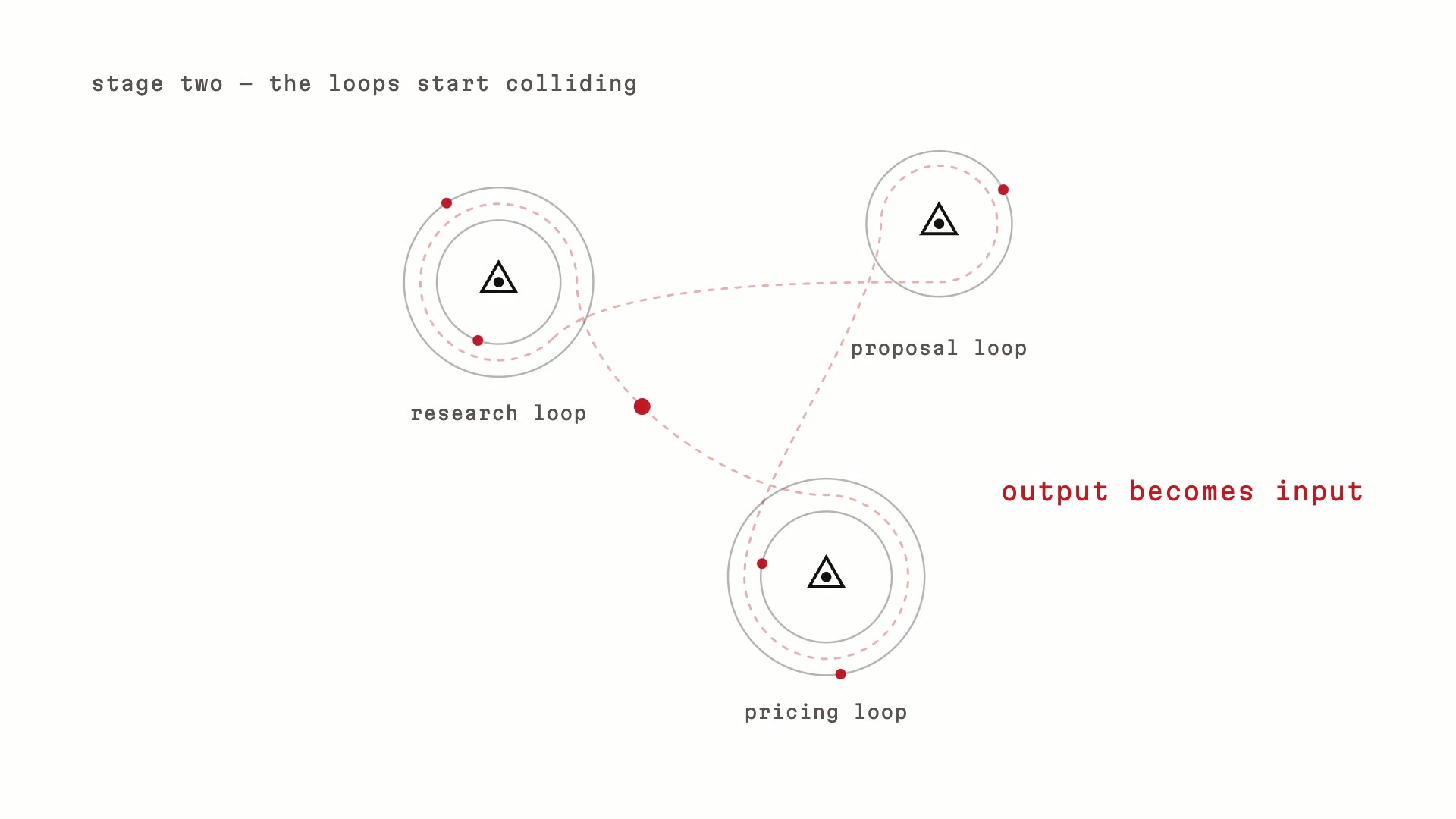
Constellations — one person’s output loop becomes the next person’s input. Private tools turn into shared infrastructure.
Then the loops start colliding, and this is where it gets fun. Your research agent’s output turns out to feed your colleague’s proposal agent. Someone’s competitive-intel loop becomes the input to someone else’s pricing loop. Wharton’s Ethan Mollick, whose research with Harvard and BCG showed that human-AI pairings outperform either working alone, describes the winning pattern as the centaur: the human holds the conductor’s baton, directing the AI rather than being driven by it. A healthy organization ends up with an orchestra’s worth of conductors whose sections have learned to trade material. The loops stop being private tools and start being shared infrastructure.
05
Elliptical orbits.
Watch what happens to a loop you have trusted for six months. It stops needing to come back so often.
The orbit stretches. Where the agent once returned hourly for approval, it now runs a full pipeline and returns at the end of the week with results and exceptions. In orbital terms it has gone from circular to elliptical, a long stretched oval of a path: the agent travels deeper into space, stays out longer, and still comes back, on a schedule you can predict, to the mass it belongs to. Comets do this. They disappear toward the edge of the solar system for years at a time, and they are not lost. They are simply on a long orbit around something they never stopped answering to.
The ellipse is earned — each time corrections per pass tick down, the orbit stretches further out, and the agent still answers to the mass at the focus.
The length of that ellipse, checked against results rather than the mere absence of complaints, is one of the most honest trust metrics your organization has. Better than the number of agents deployed, better than the tooling budget. How far out do your loops travel before they need you? A team whose agents still check in every twenty minutes has bought software. A team whose agents run for a week and return with defensible work has built gravity.
A team whose agents still check in every twenty minutes has bought software. A team whose agents run for a week and return with defensible work has built gravity.
The ellipse is earned, never assumed. Researchers have studied humans supervising semi-autonomous machines since the 1970s, and the consistent finding, from Thomas Sheridan’s control rooms to Ben Shneiderman’s human-centered AI, is that autonomy and human control rise together, or neither does. A loop earns its distance the boring way: corrections per return trip trending toward zero, exceptions handled the way you would have handled them. You stretch the orbit because the record says you can, never because approval fatigue wore you down.
And the stretch is what funds the next stage. A loop that runs for a week without you returns exactly the resource everything else in this piece competes for: your attention. Spend it digging the next well.
06
Moons.
Then one day a loop of yours does something new: it spawns a loop of its own.
Your proposal agent, halfway through a draft, kicks off a research sub-agent to chase down a market number. Your support-triage loop spins up a small worker to reproduce a bug. These sub-loops are moons: they circle the loop that made them, do their narrow job, and report back to it. Most of their work you will never see, and that is the point. You did not hire them. Your loop did.
Moons — a loop spawns sub-loops that circle it while it works. Every orbit, traced inward, still ends at a human intention.
This is the moment delegation acquires depth. You direct loops, loops direct sub-loops, and the whole arrangement holds together for one reason only: every orbit, traced far enough inward, ends at a human intention. The moon circles the planet, the planet circles the sun, and the sun is still you.
The moon circles the planet, the planet circles the sun, and the sun is still you.
07
The groundskeeper.
So what is your job, once the constellation runs?
Something different from the agent boss of the constellation stage. The boss manages agents; this final role tends trajectories. Call it interstellar groundskeeping, a deliberately earthbound word for a cosmic job, because even a solar system needs someone to pull the weeds. The work is closer to urban planning than supervision. You do not steer individual agents; you decide where the mass sits, digging new wells to pull work toward what matters now and filling in old ones so nothing keeps orbiting a dead priority. You walk a system in motion, examine paths rather than tasks, and ask the questions only a human can ask. Is this loop still pointed at something worth hitting? Has that one drifted somewhere we never intended? Which orbits have earned more distance, and which need pulling back in?
Groundskeeping — add mass where the work should go, fill the well that no longer matters, and the trajectories re-route themselves.
Be clear about what this job is, because it is easy to slide backward. Checking every output is still standing in the loop, just holding a clipboard. The groundskeeper reads trajectories in aggregate. Of this loop’s last ten runs, how many landed? What did they generate? Is it trending better or worse than last quarter? The unit of attention is the loop, never the task.
Pruning is the signature move of the role. Some loops earned their place two quarters ago and deserve retirement today, and the groundskeeper’s craft is deorbiting them before they burn attention and budget, not after. Knowing a healthy trajectory from a doomed one before the difference is obvious to anyone else: that judgment does not automate, and it is why Nadella argues human judgment gains value as AI gains capability. Deciding which orbits deserve to exist is the work the machines hand back to you.
One honest boundary. Someday a superintelligence may emerge with motivations of its own, independent of human desires, and if it arrives it will rearrange society too thoroughly for anything written here to survive. That is a different essay. This one is about the era we actually live in, where every loop that exists still exists because a person wanted something.
08
What to do this Monday.
Skip the transformation program. Pick one task that clears the bar from earlier, known cold, repeated constantly, easy to judge, cheap to get wrong, and dig your first well: one loop in orbit around yourself, tight and circular, returning often. Feed every fix back in. When corrections per pass trend toward zero, stretch the ellipse and spend the recovered attention on the next well. Then help the person at the next desk launch theirs, and watch for the first collision, because that is where the compounding starts.
The companies that pull ahead will not be the ones with the most agents. Agents are the cheap part, and getting cheaper. The scarce thing has not changed in a hundred years of management or a decade of AI: a person with intent strong enough, and judgment sharp enough, to bend everything nearby into a productive path.
So the next time somebody calls you the human in the loop, tell them the truth.
You are not in the loop. You are the center of gravity.
A Recon Sprint is how we help you pick that first task and dig the well around it — one loop, tight and circular, returning often.